Why cartoning timing decides paper cup cash flow
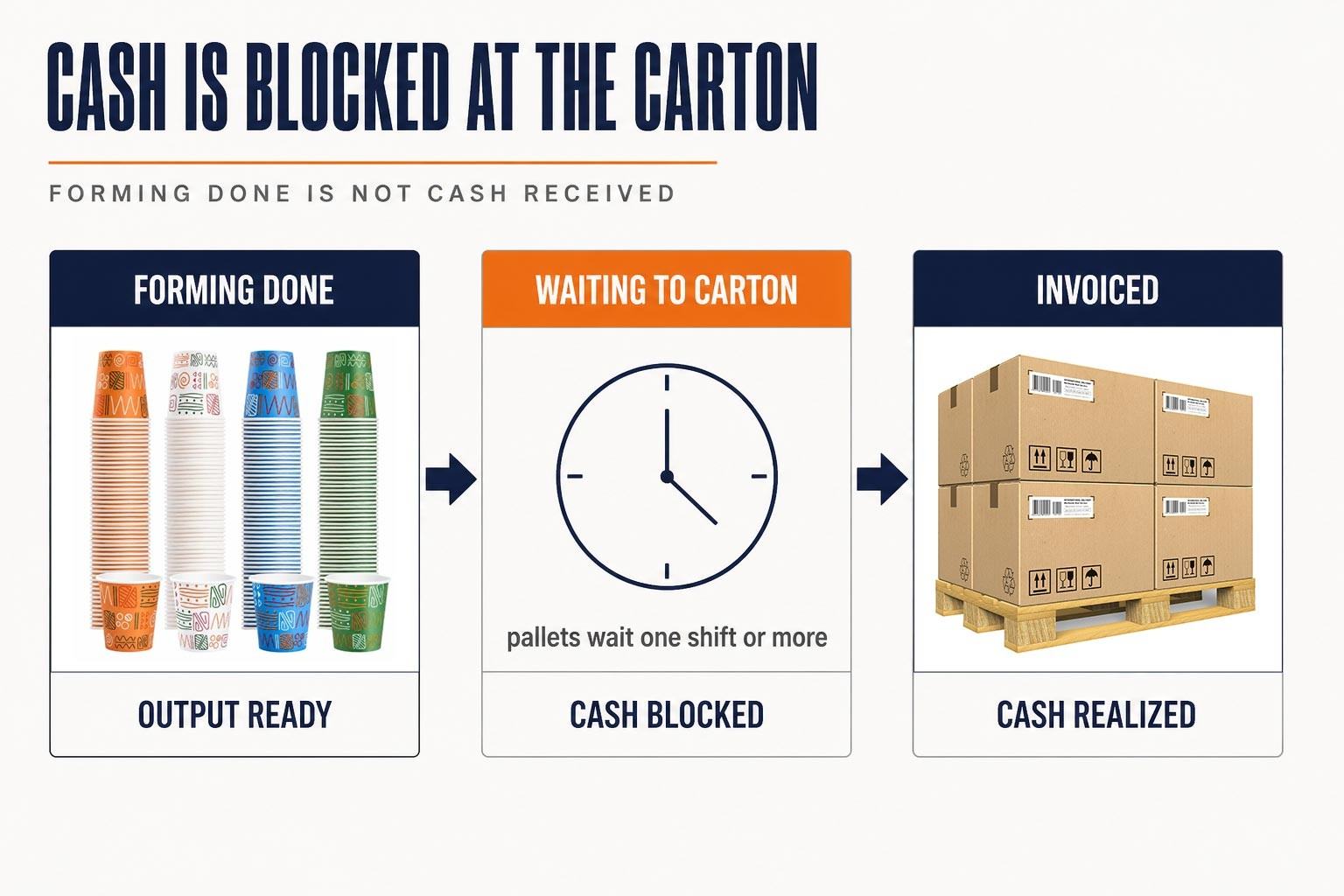
Many buyers think the paper cup cartoning machine is only a packaging finish step. In reality, it often decides how fast cash is realized after production and where working capital gets blocked. Finished cups may leave the forming area on time, but if cartons are delayed, invoices are delayed too, and labor is still consumed by unfinished pallets waiting for manual packing.
If you run a paper cup production line with variable orders, the biggest hidden risk is not only machine speed. The real question is whether each stage can clear output at the same rhythm. In many small lines, forming and packing are upgraded first, then cartoning becomes the bottleneck when order volume crosses a threshold.
This guide is for buyers evaluating when to buy a paper cup cartoning machine, how to avoid over-investment, and how to reduce order-cycle risk without guessing.
What a paper cup cartoning machine really does
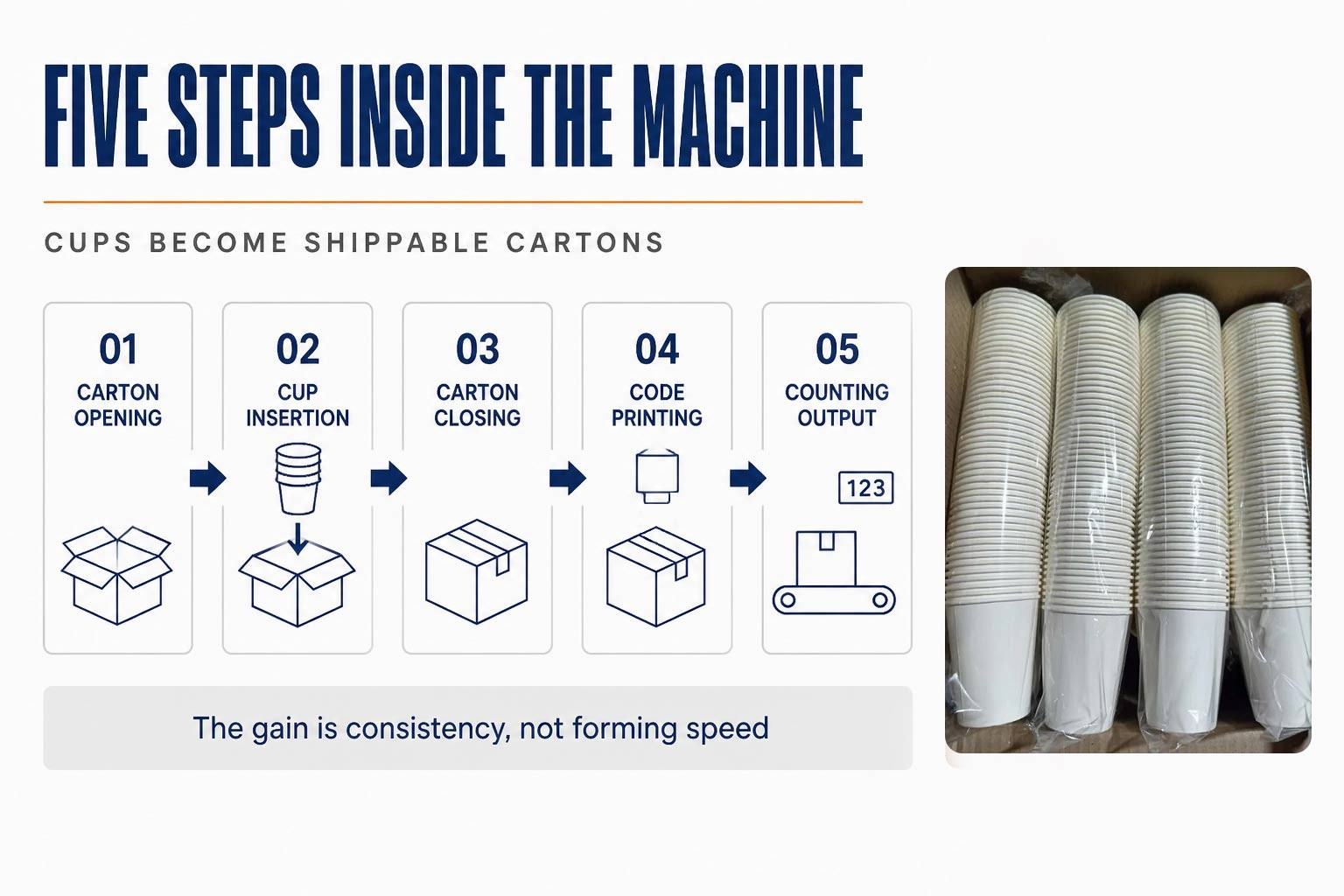
A paper cup cartoning machine stacks finished cups into cartons in a controlled rhythm. It can include carton opening, cup insertion, carton closing, code printing, and carton counting outputs depending on model depth. The practical difference is process consistency: manual cartoning is not only slower, it also consumes floor space and creates counting errors that affect delivery quality checks.
When linked with a proper counting and packaging setup, cartoning turns production output into shipment-ready units. For a buyer, this means less waiting between departments, fewer cross-checks at dock time, and clearer profit visibility by customer order.
Think of the flow this way:
paper cup fan -> printing -> die cutting -> paper cup machine -> inspection/counting -> paper cup cartoning machine -> shipment.
The role of the cartoning stage is not to increase forming speed directly. It is to stabilize shipping readiness as order size grows.
How to decide if you need a paper cup cartoning machine now
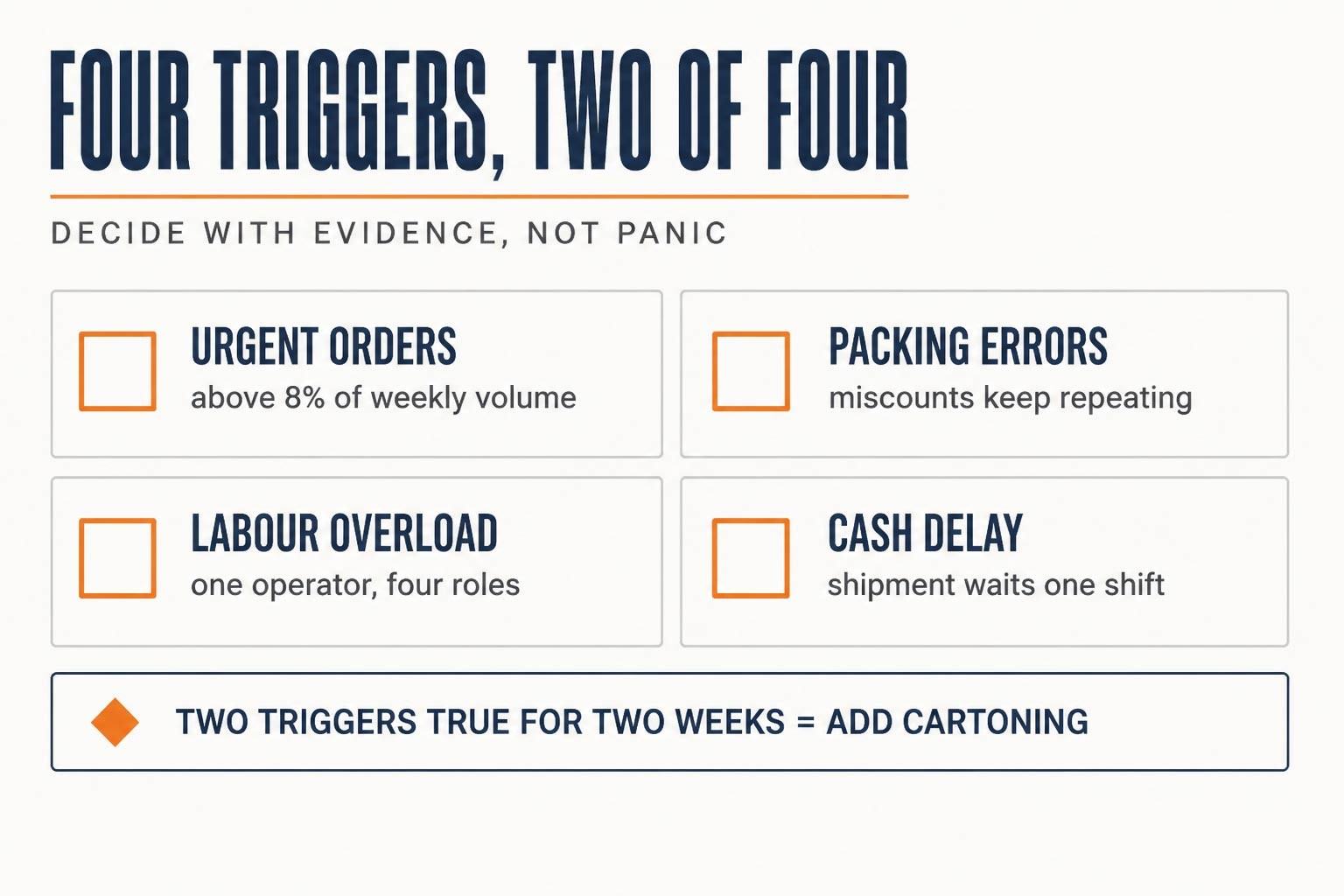
Do not decide only by today's throughput. Decide by when your current operation fails to keep up with order promise quality. The right trigger is not "I can't fill all cups by hand." It is:
- Order urgency pressure: urgent orders >8% of weekly volume, and same-day dispatch rate below target.
- Packing errors: carton mismatch or miscount appears repeatedly even after operator training.
- Labor substitution risk: one operator handles forming, sealing, counting, and manual cartoning in one shift and quality becomes unstable.
- Cash conversion delay: completed production is ready earlier, but shipment batching is delayed by one shift or more.
If at least two conditions are true for two consecutive weeks, adding paper cup cartoning machine capacity usually gives faster practical returns than adding a second forming machine.
A useful rule for distributor operations is: when cartonized order size exceeds the manual handling comfort zone, automation should not wait for a "crisis month." Buy capacity based on demand rhythm, not peak-only panic.
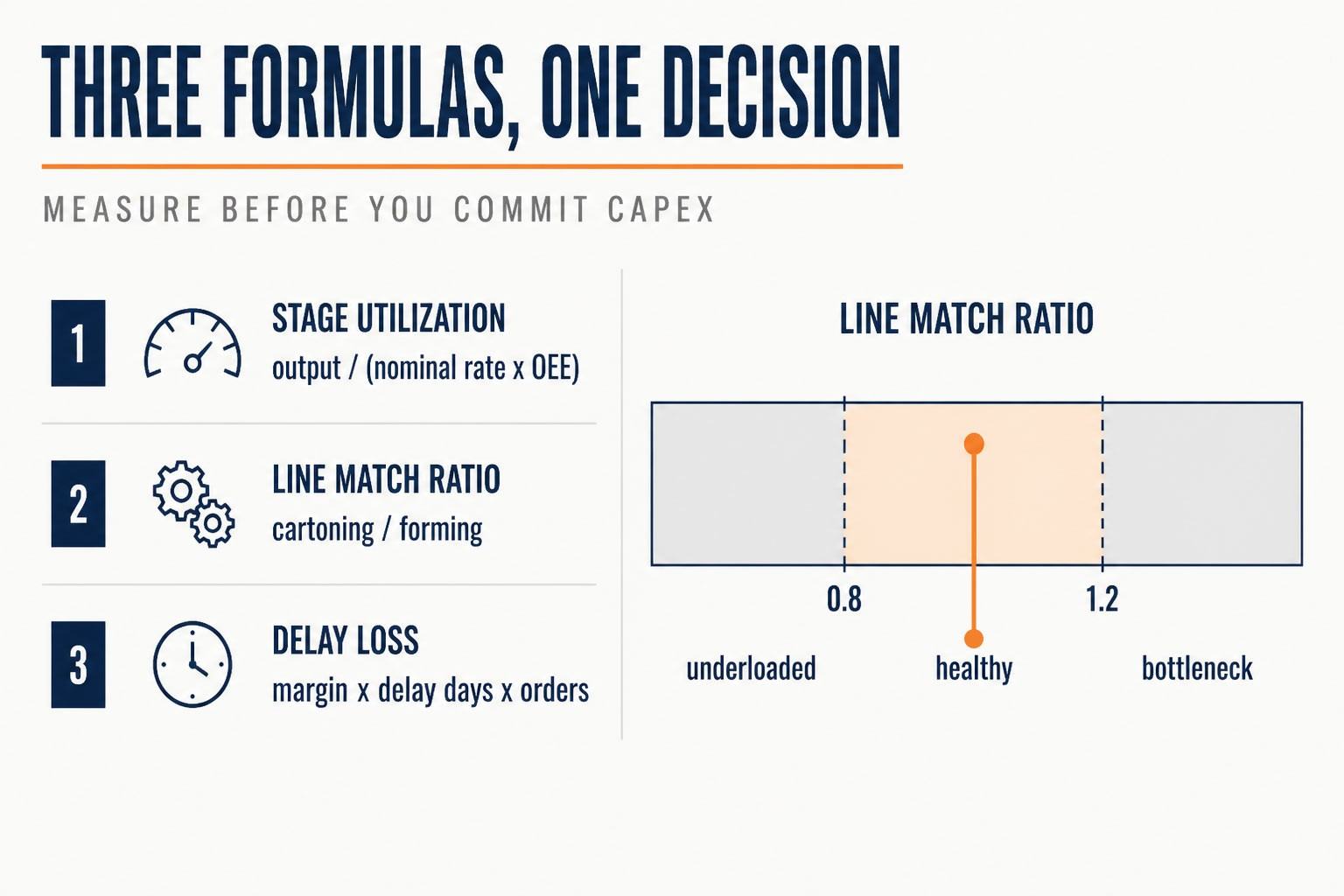
Use one short set of formulas to avoid emotional decisions.
1) Stage utilization
For each key stage, estimate real utilization:
Utilization = Average hourly output / (Nominal rate × OEE)
Run this for forming, counting, and cartonization. The stage with highest utilization has first right to upgrade attention.
2) Line match ratio
Line Match Ratio = Cartoning Utilization / Forming Utilization
- If ratio < 0.8, cartoning is underloaded. Keep manual or add other capacity first.
- If ratio between 0.8 and 1.2, balance is healthy and line timing is stable.
- If ratio > 1.2, cartoning is the bottleneck even if your machine itself is not overloaded.
3) Order-to-cash impact
Track practical order cost impact for one day of delay:
Order Delay Loss = Avg daily contribution margin per order type × Avg shipping delay days × Unshipped orders
This usually converts discussion from "machine is expensive" to "how much margin is tied in dispatch delay." If this loss is larger than the depreciation burden of a cartoning upgrade within expected cycle, upgrade is often justified.
Use the same table format every month. It makes decisions auditable and prevents one-week intuition from dominating one quarter of cash flow.
How to connect cartoning to the full production line
A paper cup cartoning machine works best when upstream and downstream steps are synchronized. In practice, most line failures come from sequencing, not speed.
| Stage | Why it matters | Practical control |
|---|
| Paper cup production | Output shape and size consistency determine carton fit quality. | Keep size verification in the first pass and record cup family tags. |
| Inspection/counting | Reject control must match carton line input quality. | Use one defect code standard across teams, not separate naming. |
| Cartoning | Inconsistent carton feed causes idle time even with clean upstream output. | Plan standardized carton type and reserve one replacement carton lot. |
| Shipping | Shipment lead-time affects repeat orders and margin stability. | Set a cut-off time and avoid mixed-order packaging slots. |
If your line already has a paper cup packing machine or an integrated bagging step, verify carton format consistency before adding cartoning automation. Otherwise the new machine will simply shift waiting to the next station.
Upgrade path: packing-first vs forming-first sequence
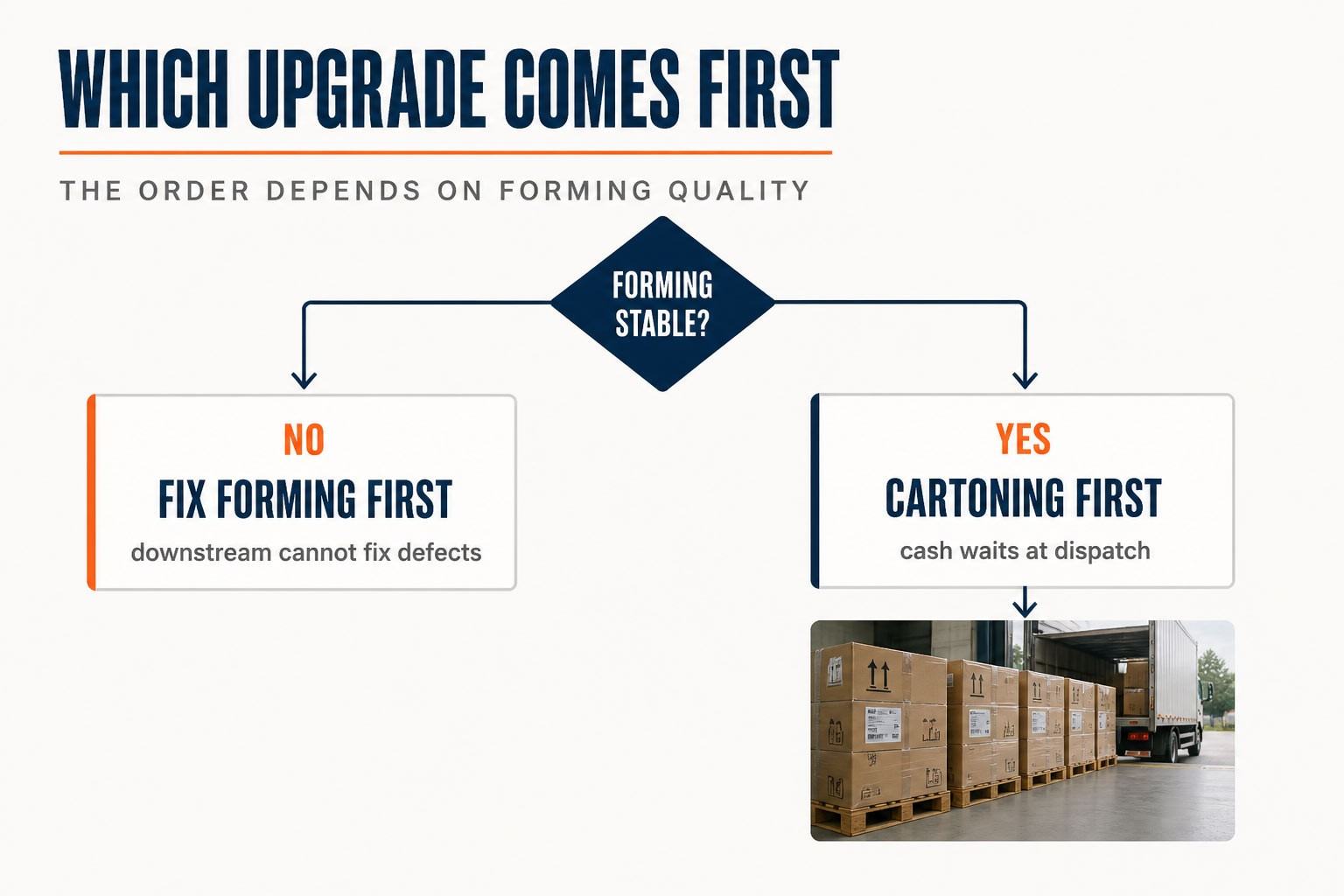
Most people assume they should buy forming headcount first. That is not always optimal for order quality. In many small paper cup production line cases, carton-ready capacity creates the first measurable gain in cash conversion.
| Scenario | First upgrade usually should be | Reason |
|---|
| Steady forming, slow dispatch, many urgent small orders | paper cup cartoning machine before second forming tool | Dispatch speed limits margin and reputation more than forming. |
| Frequent reject from paper cup machine, unstable cup wall quality | Forming stability first | Downstream cannot improve defective material quality. |
| High mix of sizes and print versions | Cartoning with flexible setup + process standardization | Mixing control requires fast output and clear packaging logic. |
This ordering logic is not universal. If your forming stage is unstable, cartoning before forming control will only make defects look cleaner, not disappear. But when forming is stable and cash is waiting at dispatch, cartoning often improves order performance faster.
Comparison matrix and workflow sequence
| Option | Capital intensity | Order suitability | Main benefit |
|---|
| Manual cartoning + manual counting | Very low | Very small volumes only | Low fixed cost at start |
| Semi-automatic carton table + counting | Low to medium | Medium repeat orders | Lower labor variability |
| Semi-automatic or automatic paper cup cartoning machine | Medium | Mixed retail and B2B demand | Consistent carton output and stable shipping rhythm |
| Integrated carton and packing automation with coding | Higher | High turnover channels and strict logistics windows | Fast dispatch and lower dispatch error probability |
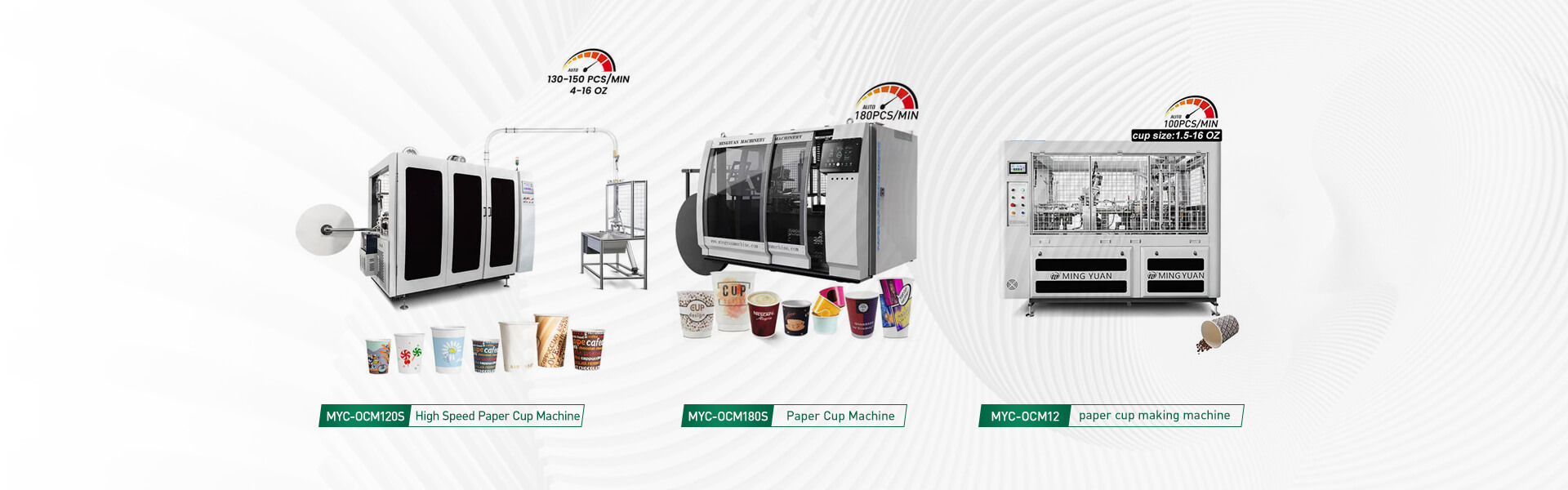
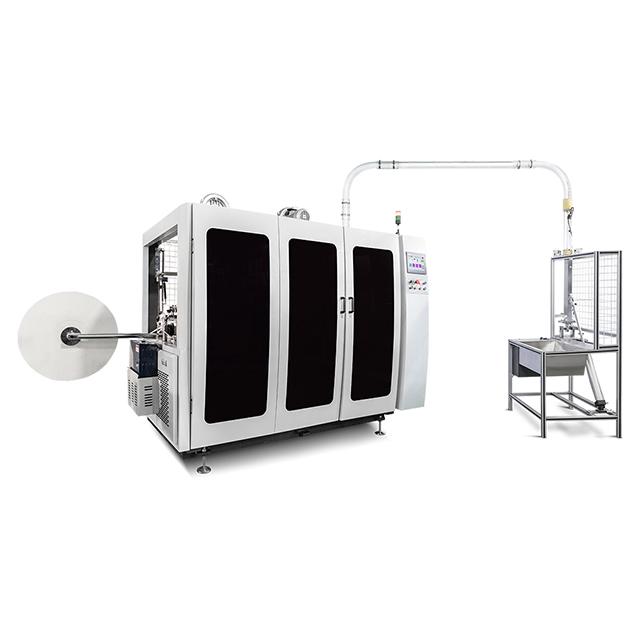
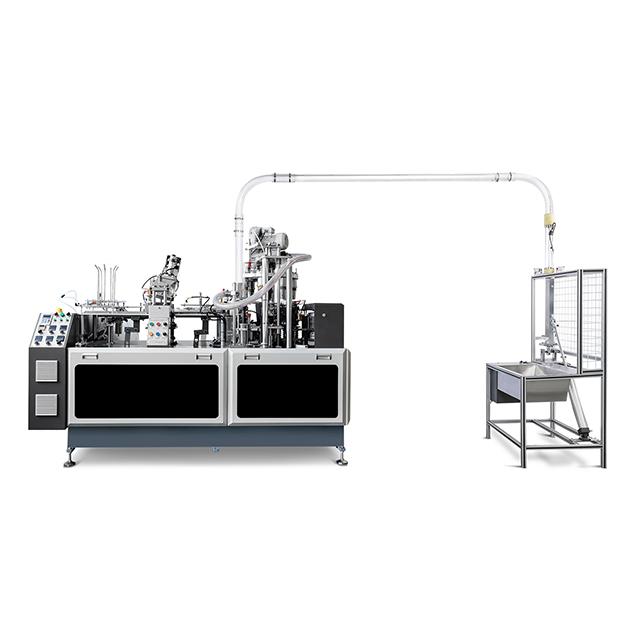
For most buyers, the best sequence is often:






 Tel: +86-19057361870 / +86 577 65567060
 Email: george@paper-cupmakingmachine.com
 MP/WhatsApp: +86-19057361870
 Manufacturer Address:No.1588, Huaming Road, Feiyun Street,Ruian City Zhejiang Province -325200 China