What Should Buyers Compare First?
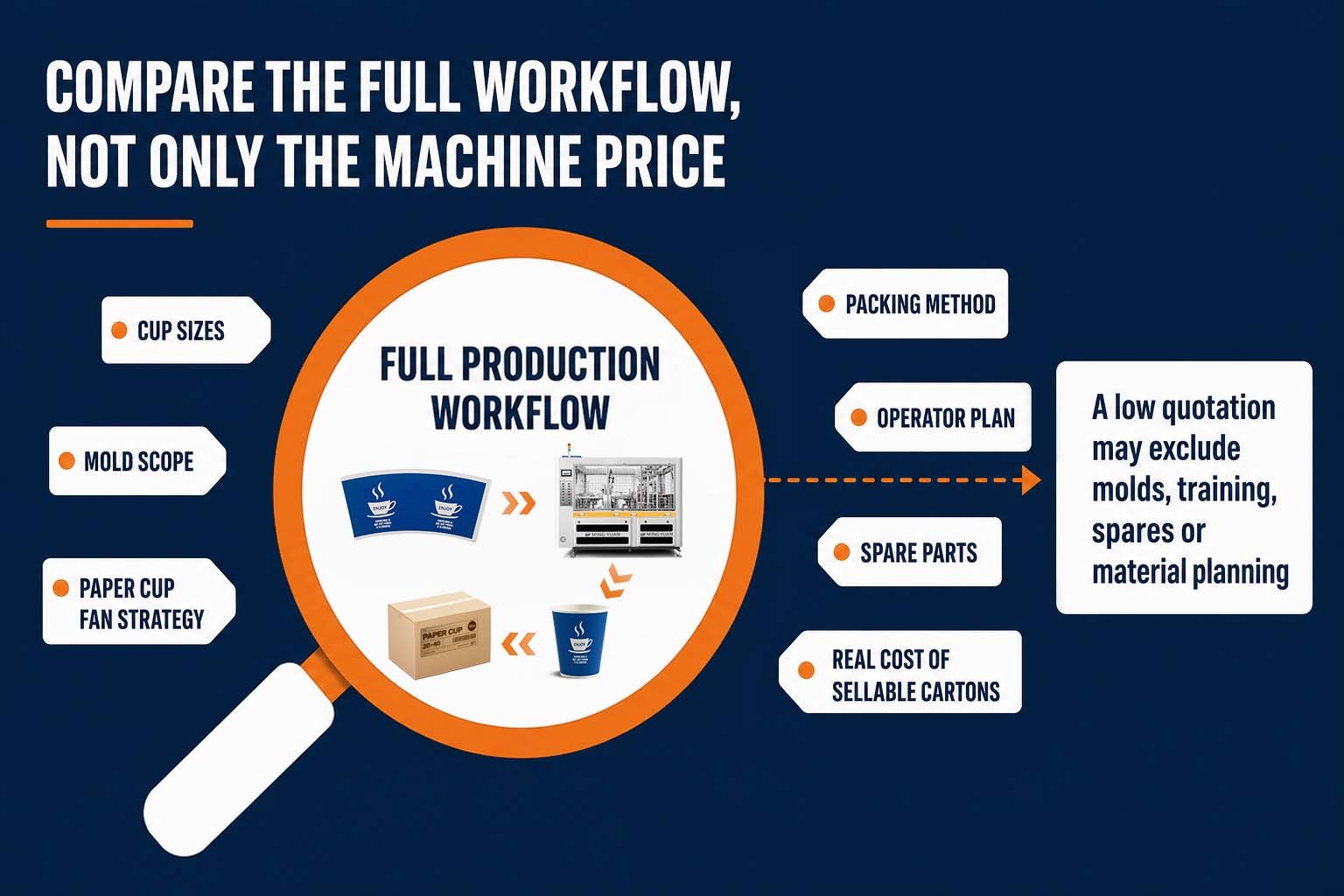
When buyers search for a machine for paper cup production, they usually want to know which quotation is safer, not only which machine price is lower. The first comparison should include cup sizes, mold scope, paper cup fan strategy, packing method, operator plan, spare parts, and the real cost of turning formed cups into sellable cartons.
A low quotation can look attractive, but it may exclude molds, training, packing needs, spare parts, or the material planning that makes production stable. A higher quotation may also be unnecessary if the buyer only needs a narrow startup setup for local repeat orders.
For buyers comparing a paper cup machine, the practical rule is simple: compare the full production workflow, not only the forming machine price.
What Should Be Inside a Machine Quote?
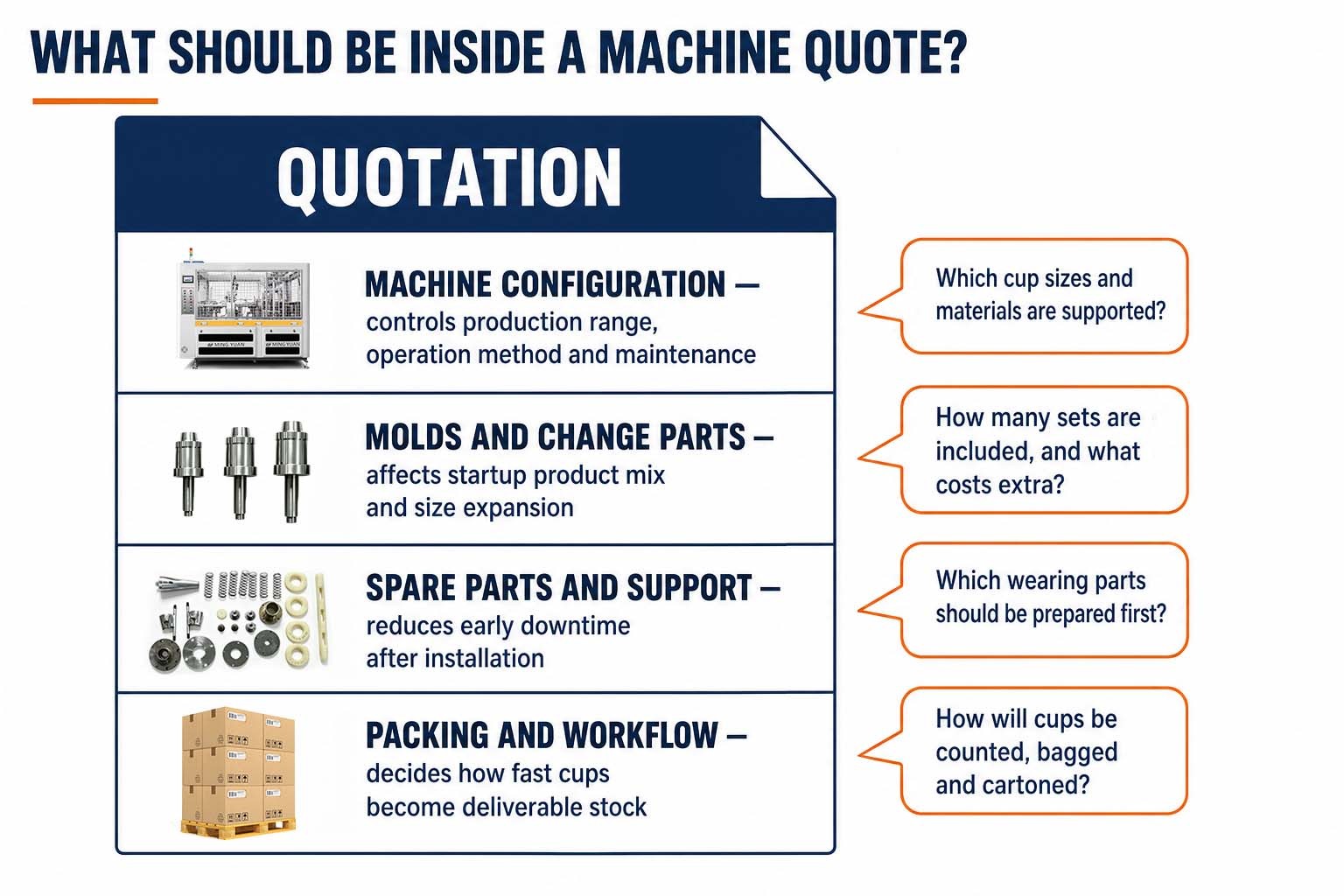
A useful quotation should help the buyer understand what is included, what is excluded, and what must be prepared separately. If the quote only lists a model name and a machine price, the buyer still has to calculate the real project cost by himself.
| Quote Item | Why It Matters | Question to Ask |
|---|
| Machine configuration | Controls production range, operation method, and maintenance needs | Which cup sizes and materials does this setup support? |
| Molds and change parts | Affects startup product mix and future size expansion | How many sets are included, and what costs extra? |
| Spare parts and support | Reduces early downtime after installation | Which wearing parts should be prepared for the first months? |
| Packing and workflow | Decides whether cups become deliverable stock quickly | How will cups be counted, bagged, and cartoned? |
Why Are Quotations Different?
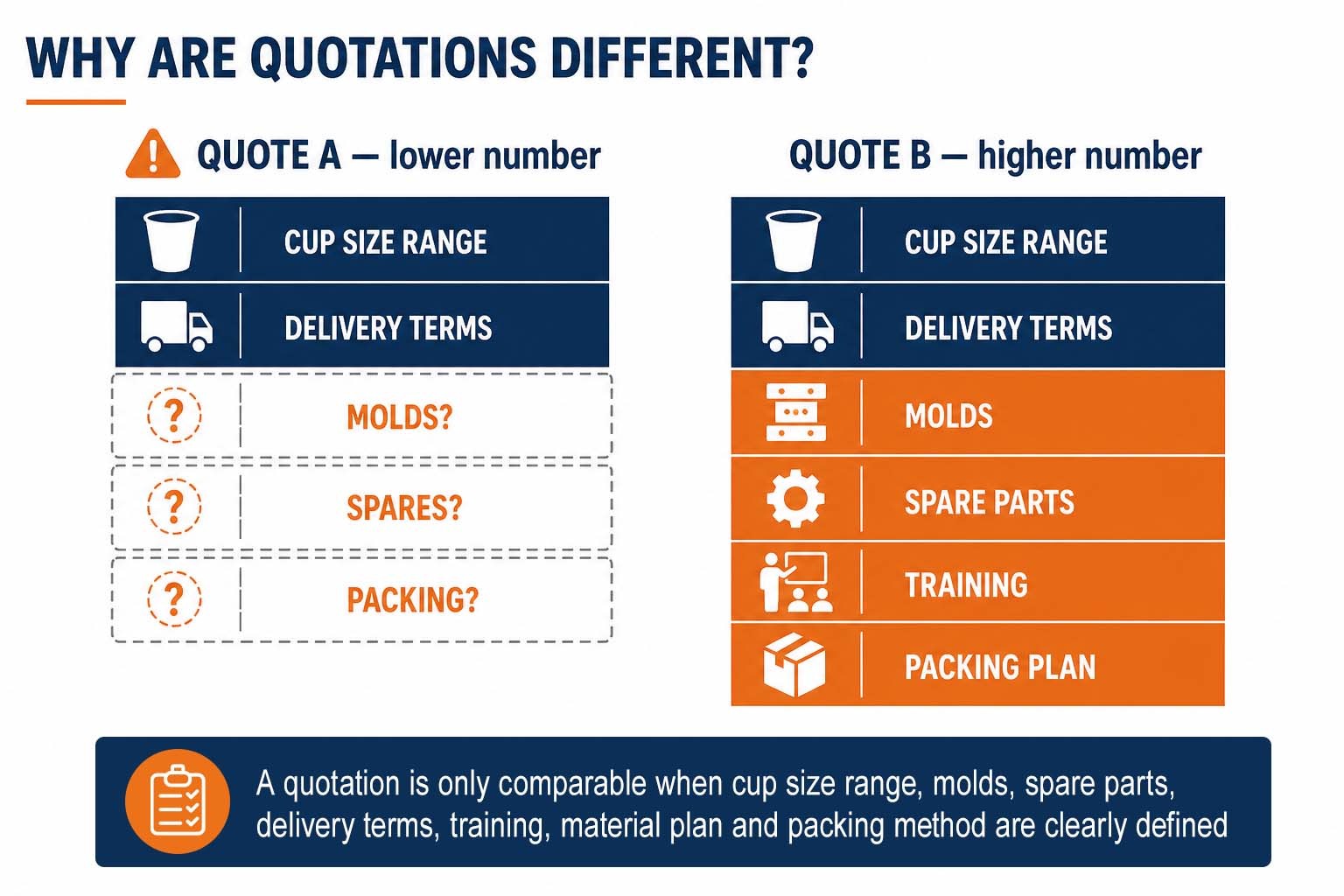
Paper cup machine price can vary because different suppliers may quote different machine structures, automation levels, mold packages, auxiliary equipment, packaging methods, and after-sales scope. Two quotations may look similar on the surface but support different factory plans.
The buyer should avoid comparing only the final number. A machine for paper cup production is part of a workflow that includes paper cup fan preparation, cup forming, inspection, counting, bagging, cartons, storage, and delivery. If one quote includes a stronger startup package and another excludes key preparation items, the cheaper quote may not be the lower-risk choice.
Comparison rule
A quotation is only comparable when cup size range, molds, spare parts, delivery terms, training, material plan, and packing method are clearly defined.
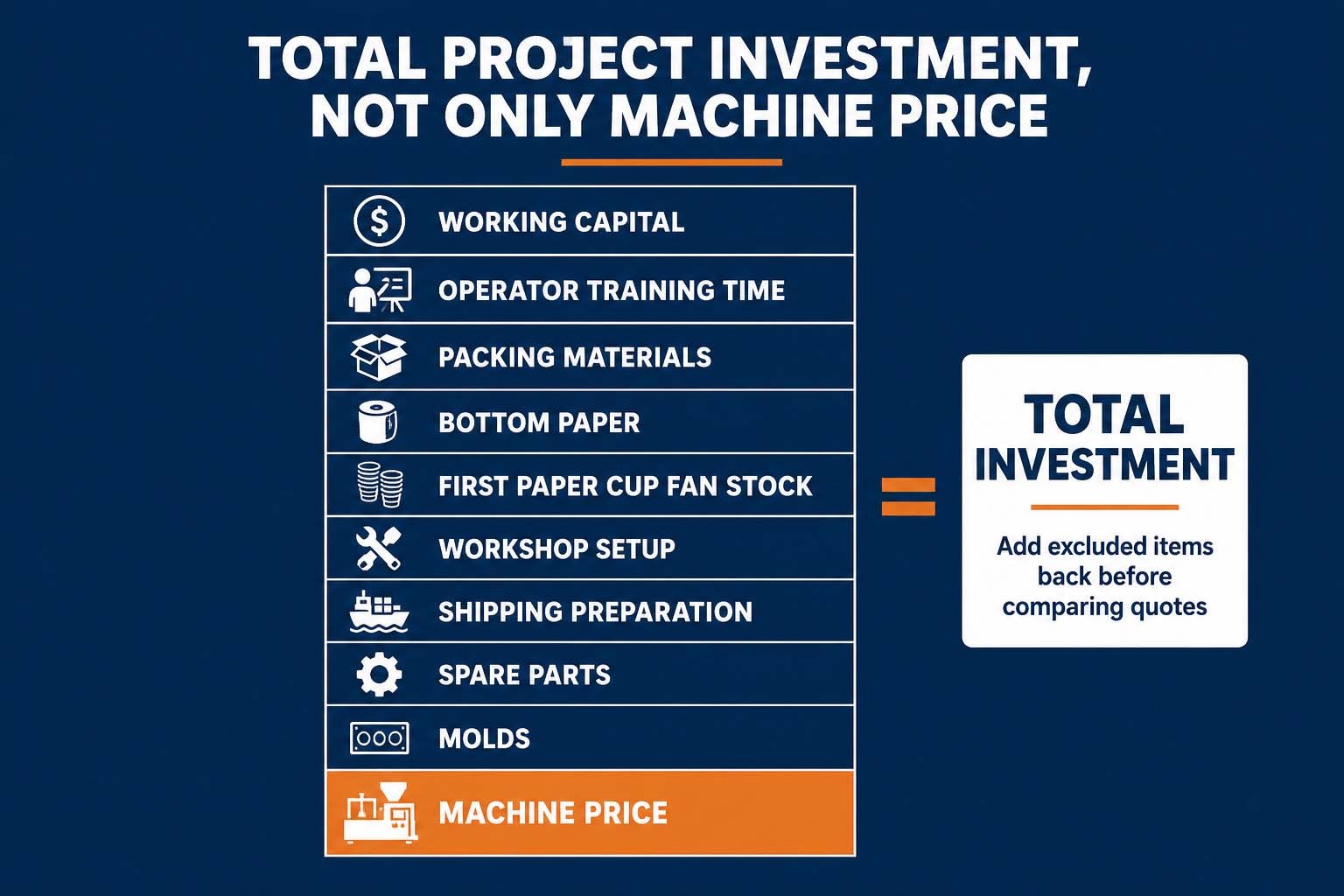
For a startup buyer, the real investment is not only the price of the forming machine. It also includes the items needed to produce, inspect, pack, and deliver the first commercial orders. A simple formula helps prevent budget gaps.
Total project investment
Total investment = machine price + molds + spare parts + shipping preparation + workshop setup + first paper cup fan stock + bottom paper + packing materials + operator training time + working capital.
This formula is not meant to create a fixed number for every country. It is a checklist for honest comparison. If one quotation looks cheaper because it excludes necessary startup items, the buyer should add those items back before making a decision.
How Paper Cup Fan Planning Changes Cost
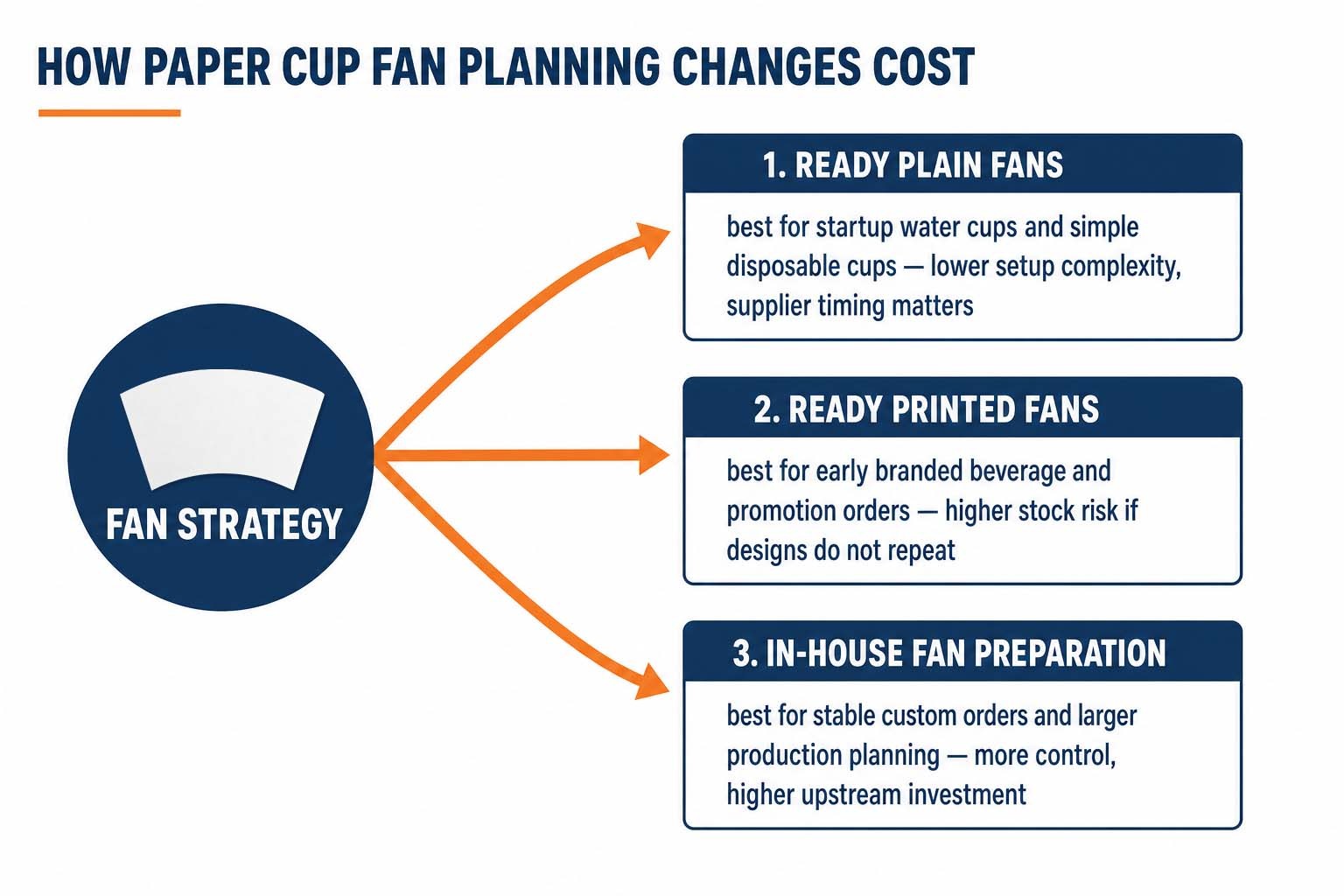
Paper cup fan planning affects the buyer's cash flow more than many new factories expect. Ready fans can make startup faster and simpler. Printed fans support branded cup orders but may create stock risk if the customer changes the design or reduces order volume. In-house printing and die cutting can improve control later, but they add equipment, operators, setup waste, and management work.
| Material Strategy | Best Use | Cost Impact |
|---|
| Ready plain fans | Startup water cups and simple disposable cups | Lower setup complexity, but supplier timing matters |
| Ready printed fans | Early branded beverage and promotion orders | Higher stock risk if designs do not repeat |
| In-house fan preparation | Stable custom orders and larger production planning | More control, but higher upstream investment |
Which Quote Fits Different Buyers?
| Buyer Situation | Better Quote Direction | Reason |
|---|
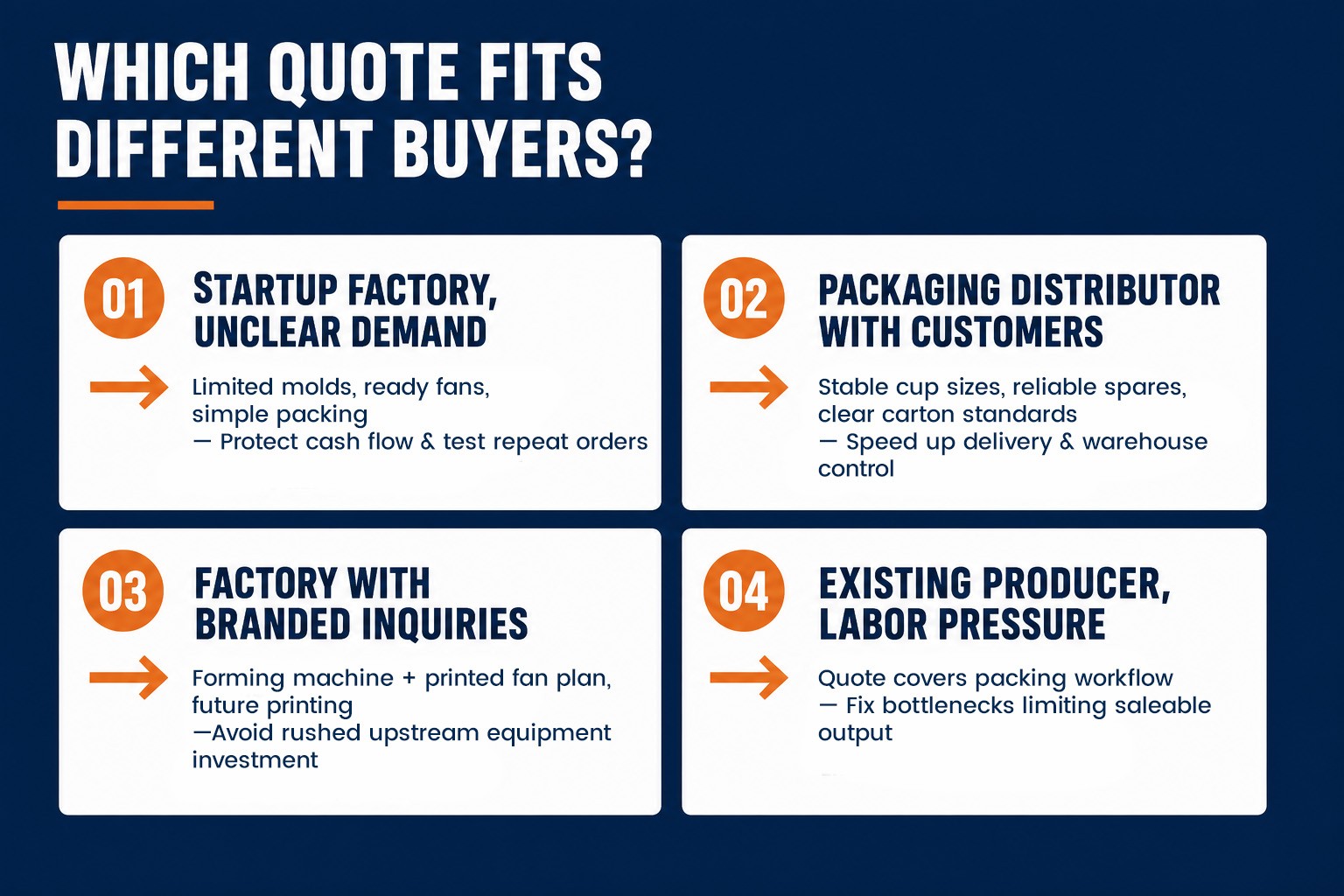
| Startup factory with unclear demand | Limited molds, ready fans, simple packing plan | Protects cash flow while testing repeat orders |
| Packaging distributor with existing customers | Stable cup sizes, stronger spare parts, clear carton standards | Supports delivery speed and warehouse control |
| Factory receiving branded cup inquiries | Forming machine plus printed fan plan, with future printing and die cutting option | Avoids rushing into upstream equipment too early |
| Existing cup producer with labor pressure | Quote that includes packing workflow discussion | Solves the bottleneck that limits sellable output |
Why Packing Belongs in the Comparison
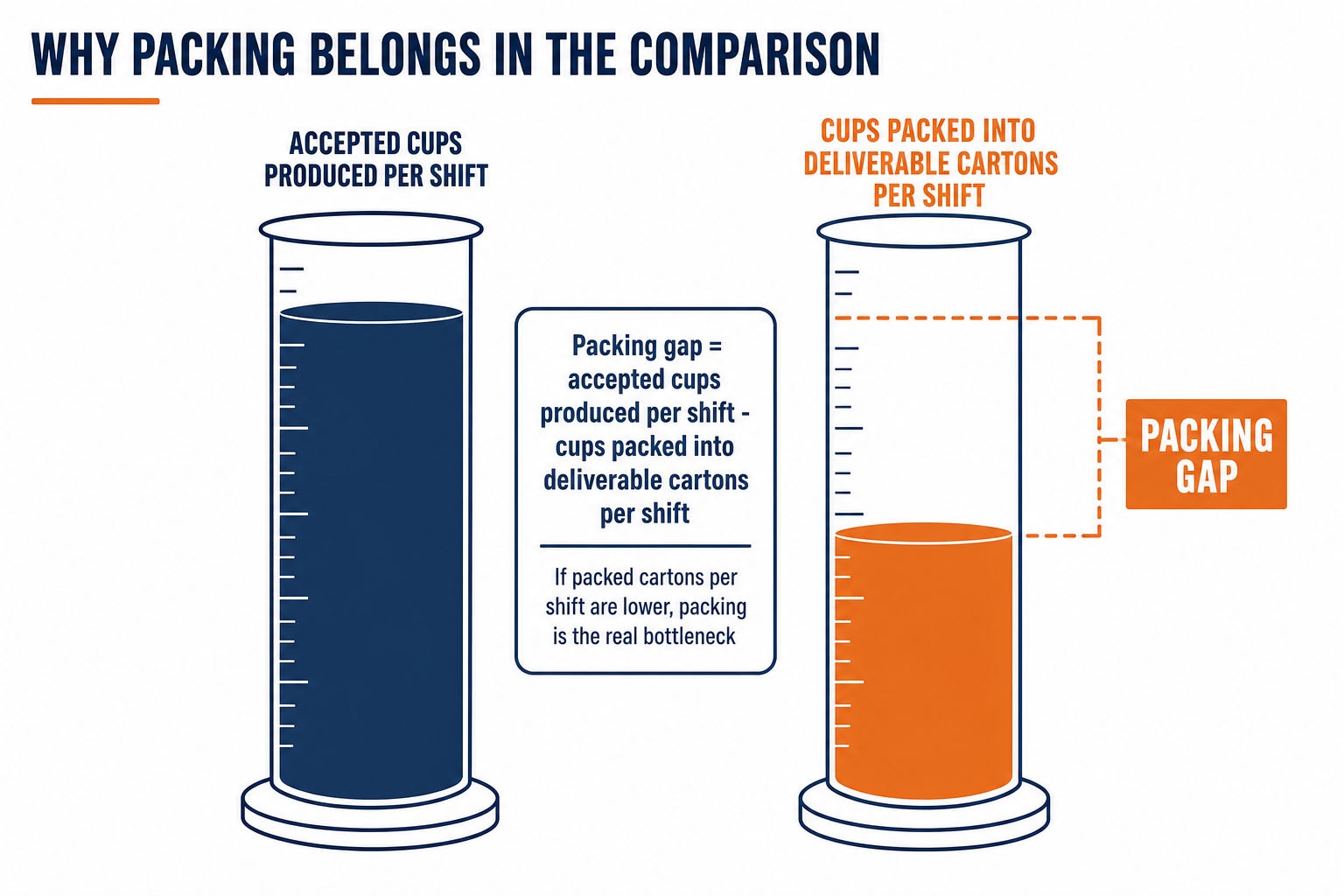
Buyers often compare forming machine output but forget that customers receive packed cups. Counting, bagging, sealing, carton loading, and labeling can become the real production limit, especially for distributors that need consistent delivery batches.
A paper cup packing equipment plan does not always mean buying automatic packing on day one. It means defining cups per bag, bags per carton, packing labor, finished goods storage, and the point where manual packing becomes too slow. If packed cartons per shift are lower than accepted formed cups per shift, packing is the real output bottleneck.
Packing gap formula
Packing gap = accepted cups produced per shift - cups packed into deliverable cartons per shift.
How to Compare Cost per Packed Cup
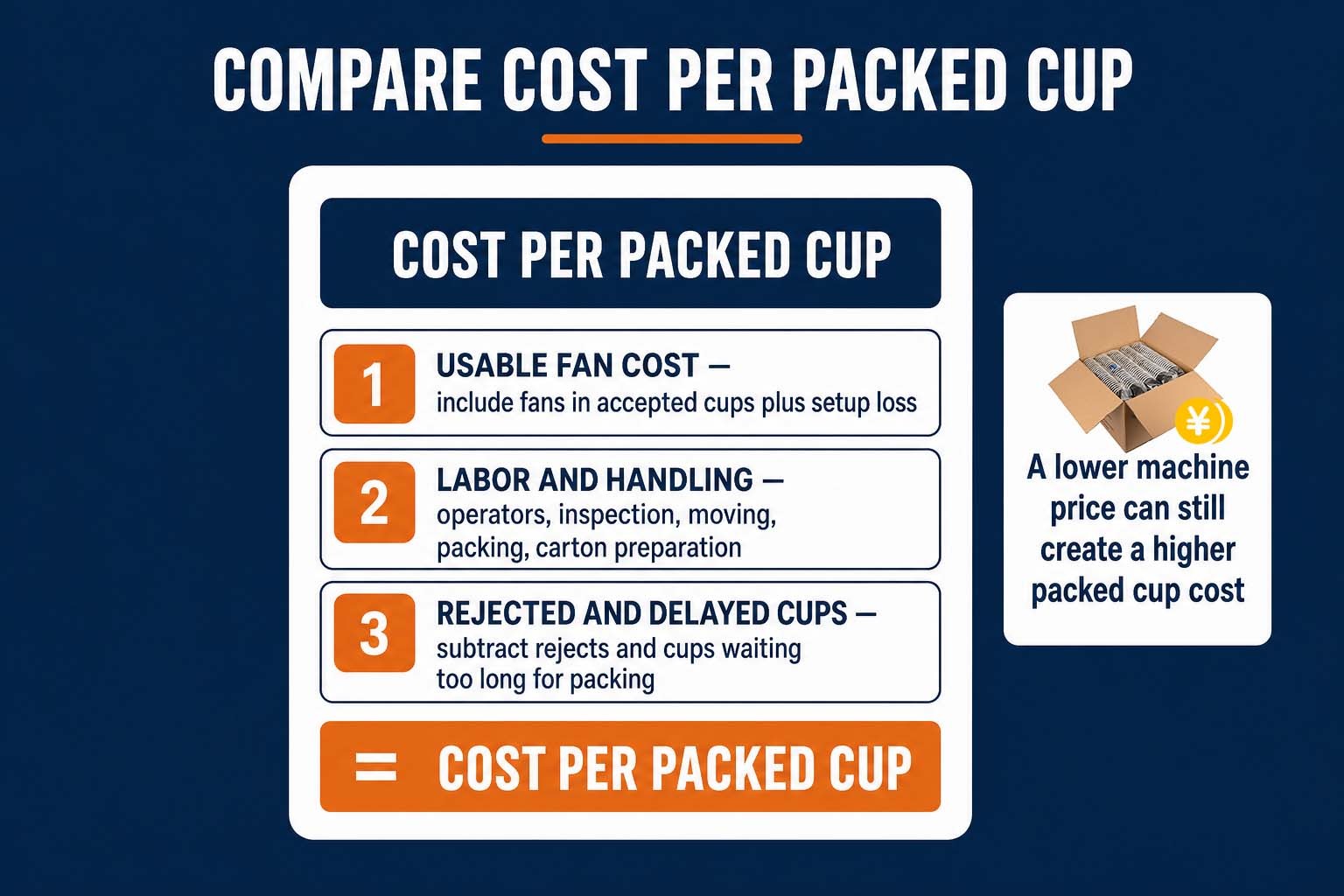
After the buyer has total investment, the next comparison should be cost per packed cup. This is more useful than machine speed because it connects the quotation with sales price, material waste, labor pressure, and delivery readiness. A machine that looks cheaper may produce higher cost per packed cup if waste is high, changeover is slow, or packing requires too much labor.
| Cost Item | How to Estimate It | Why Buyers Miss It |
|---|
| Usable fan cost | Include paper cup fans used in accepted cups and fans lost during setup | Many plans count only ideal material use |
| Labor and handling | Include operators, inspection, moving cups, packing, and carton preparation | Labor after forming is often treated as a small detail |
| Rejected and delayed cups | Subtract rejected cups and cups waiting too long for packing | Output is sometimes calculated from formed cups, not sellable cups |
The quote that creates the lower packed cup cost is usually more valuable than the quote with the lowest machine price. This is especially true for buyers serving distributors, restaurants, beverage shops, and food service customers that care about stable carton delivery.
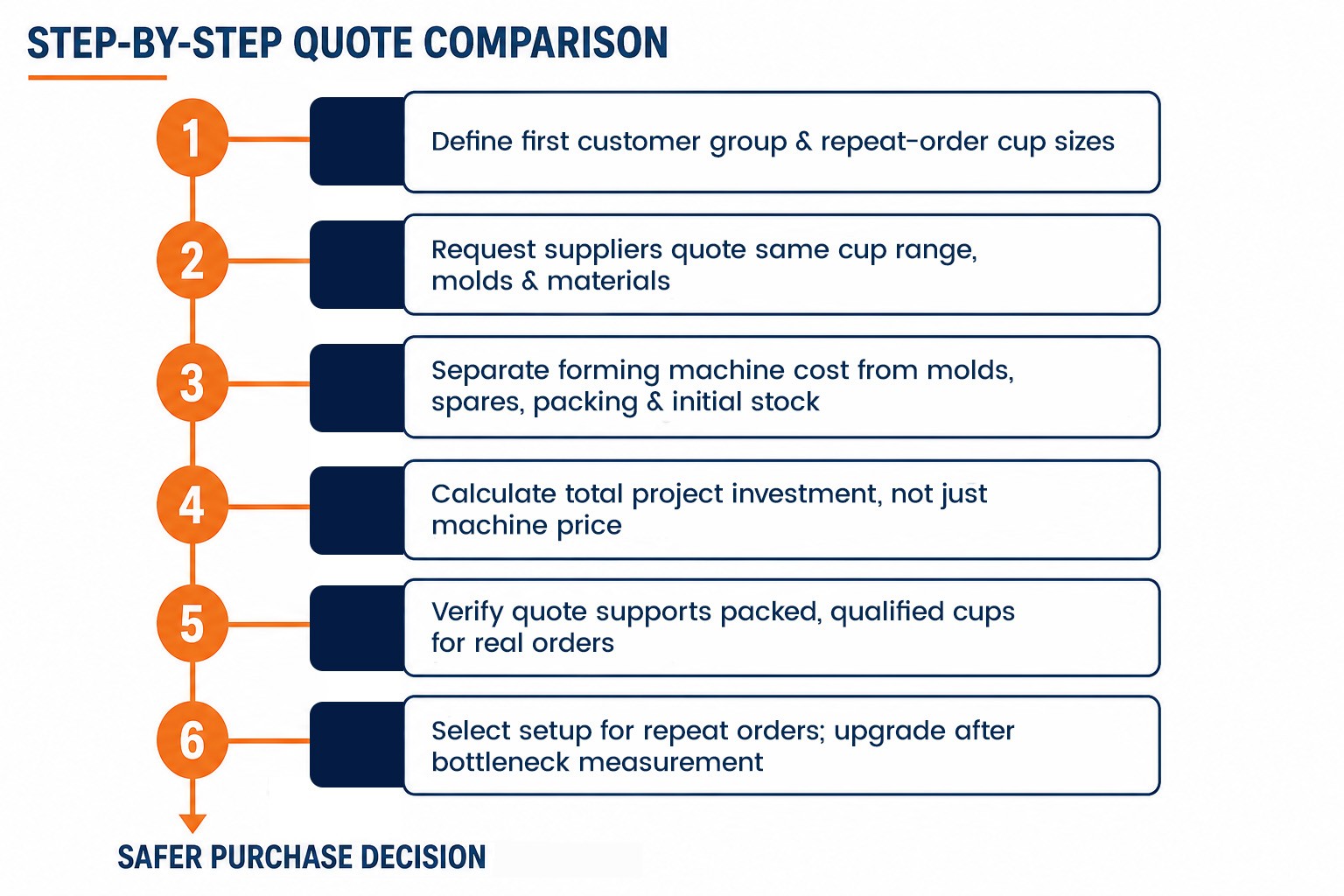
Step-by-Step Quote Comparison
- Define your first customer group and the cup sizes most likely to repeat.
- Ask each supplier to quote the same cup size range, mold scope, and material direction.
- Separate forming machine price from molds, spare parts, packing, and first material stock.
- Calculate total project investment, not only the machine price.
- Check whether the quote helps you produce packed, accepted cups for real orders.
- Choose the setup that fits repeat orders and upgrade only after bottlenecks are measured.
Quotation Red Flags
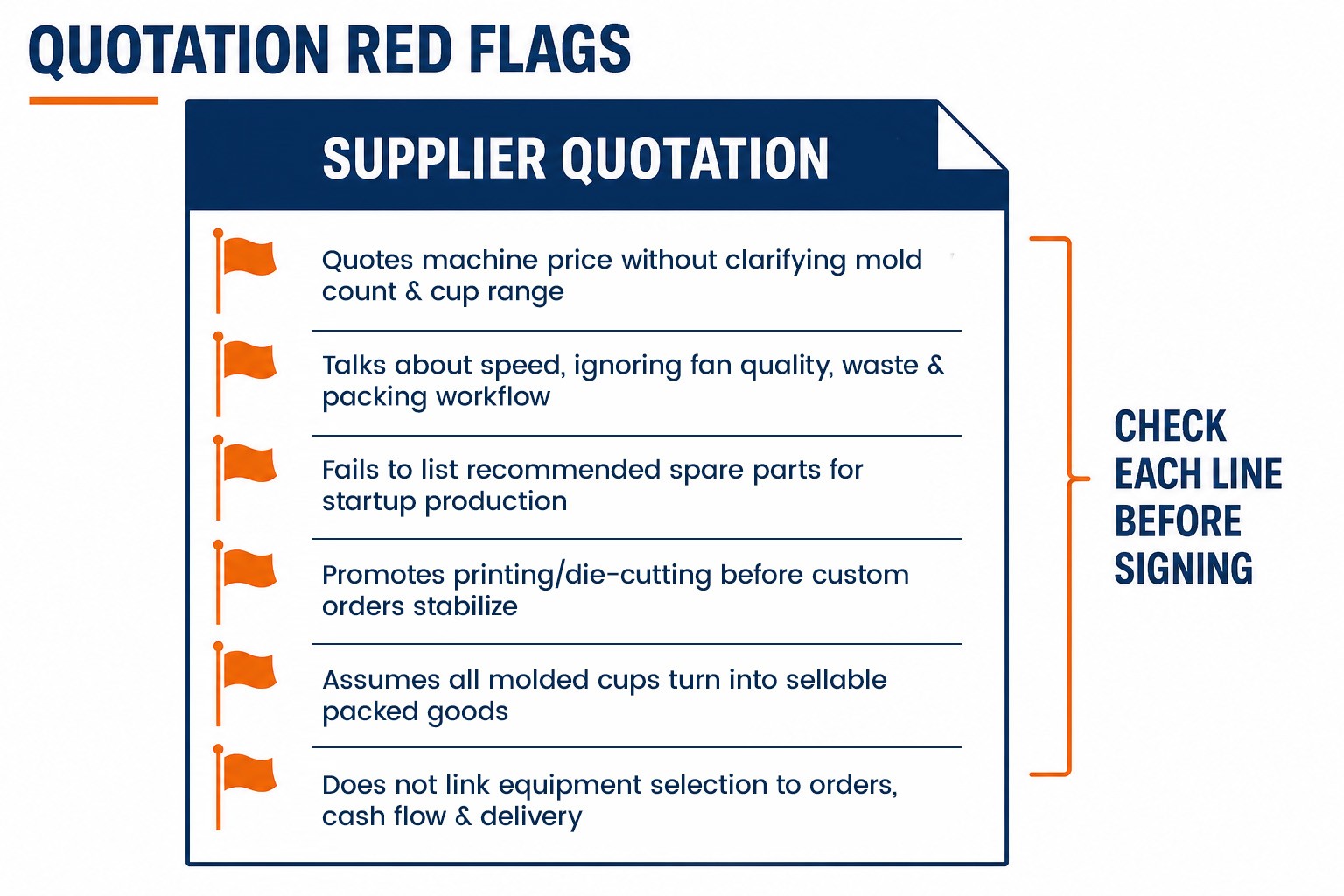
- The quote gives a machine price but does not clarify mold quantity or cup size range.
- The supplier discusses speed but not paper cup fan quality, waste, or packing workflow.
- The buyer cannot see which spare parts are recommended for early production.
- The quote pushes upstream printing and die cutting before custom orders are stable.
- The production plan assumes all formed cups become sellable packed cups.
- The quotation does not connect equipment choice with first orders, cash flow, or delivery timing.
Buyer Checklist Before Ordering
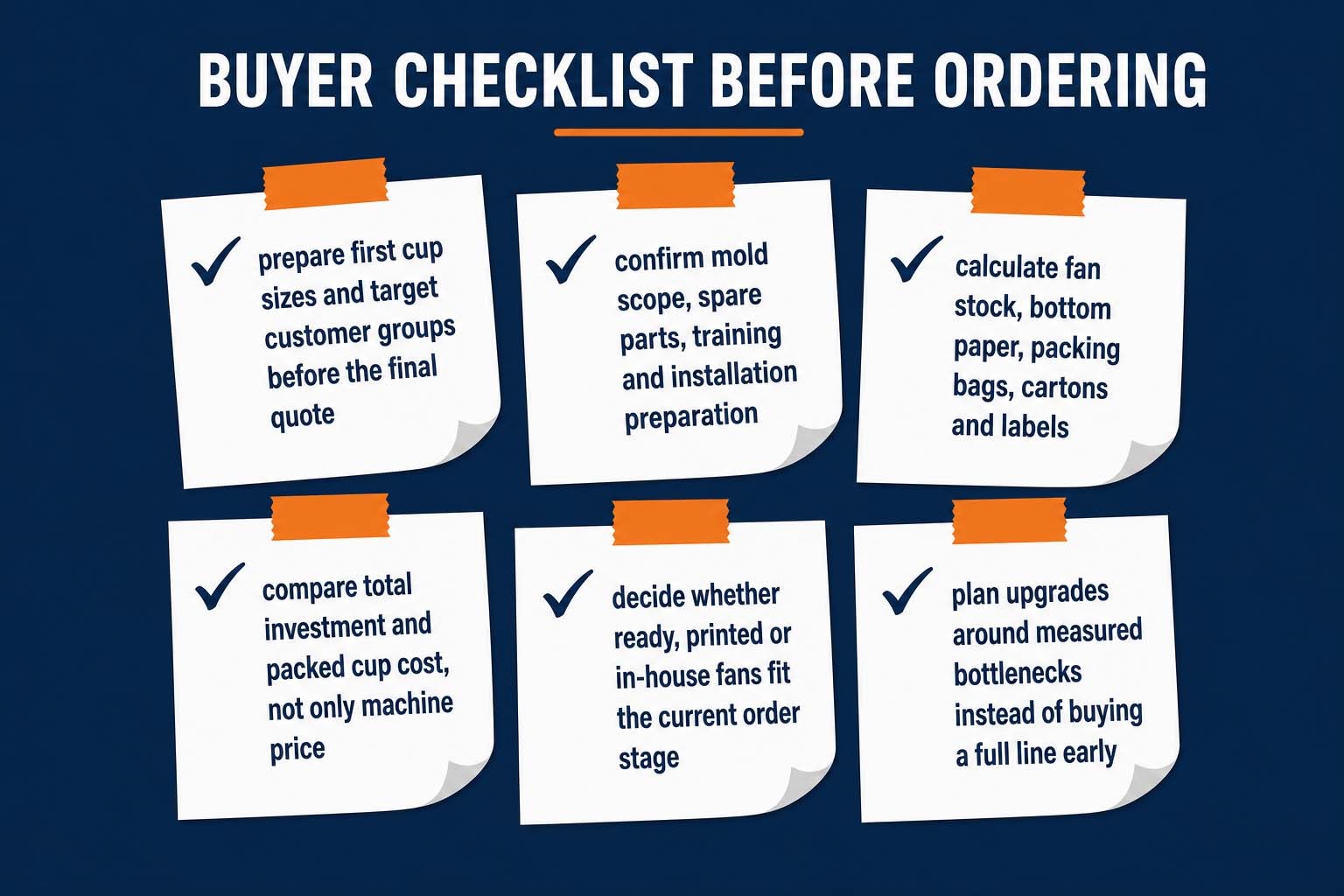
- Prepare the first cup sizes and target customer groups before requesting the final quote.
- Confirm mold scope, spare parts, training, and installation preparation clearly.
- Calculate first paper cup fan stock, bottom paper, packing bags, cartons, and labels.
- Compare total investment and packed cup cost, not only the forming machine price.
- Decide whether ready fans, printed fans, or in-house fan preparation fits the current order stage.
- Plan future upgrades around measured bottlenecks instead of buying a full line too early.
Frequently Asked Questions
Why should I not compare only paper cup machine price?
Because the machine price does not show the full startup cost. Molds, spare parts, first material stock, packing materials, labor, workshop preparation, and working capital can all affect the real investment.
What is the most important hidden cost for new buyers?
Material and packing are often underestimated. Paper cup fan stock, bottom paper, setup waste, rejected cups, bags, cartons, and labels all affect finished cup cost.
Should I buy a complete paper cup production line immediately?
Not always. A complete line is useful when order volume and workflow needs are clear. Startup buyers can often reduce risk by starting with forming and simple packing, then adding upstream or downstream equipment after real bottlenecks appear.
When does in-house printing and die cutting make sense?
It makes sense when custom printed cup orders are stable enough to justify the extra equipment, operators, setup time, and waste control. For early orders, ready paper cup fans may be simpler.
How can I make supplier quotations easier to compare?
Ask every supplier to quote the same cup sizes, mold scope, material direction, spare parts list, packing assumptions, and support scope. Then compare total investment and packed cup output.
The Bottom Line
A machine for paper cup production should be compared through total investment, finished cup cost, material planning, packing workflow, and upgrade timing. The lowest quotation is not always the lowest-risk factory setup.
The safest quote is the one that matches repeatable orders, includes the necessary startup scope, and helps the buyer deliver packed, accepted cups with measurable cost control.
Before ordering, prepare your first product mix, target customers, material strategy, packing standard, and total investment worksheet. This keeps the buying decision connected to real orders instead of a single machine price.





 Tel: +86-19057361870 / +86 577 65567060
  Email: george@paper-cupmakingmachine.com
 MP/WhatsApp: +86-19057361870
 Manufacturer Address:No.1588, Huaming Road, Feiyun Street,Ruian City Zhejiang Province -325200 China